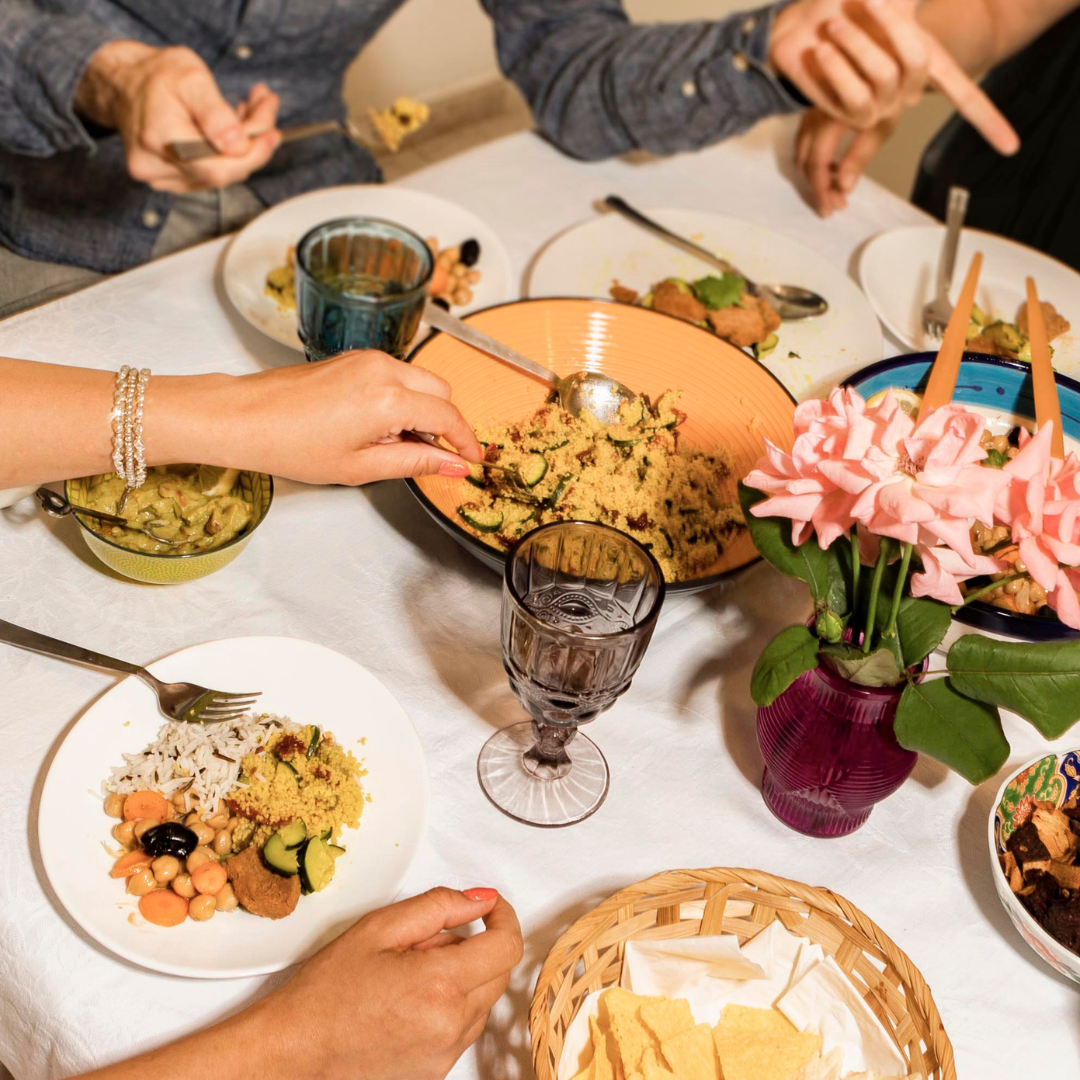
Take a moment at the end of each week to feel refreshed and rejuvenated with this collection of traditional and creative Shabbat rituals, blessings, and activities.

Learn more about Shabbat
Shabbat, also known as Shabbos and the Sabbath, is a Jewish weekly day of rest that begins every Friday night at sundown and ends every Saturday night when three stars appear in the sky. Traditionally it’s celebrated by taking a break from anything that is considered work–both physically and emotionally. Shabbat begins with a candle-lighting ceremony which is often followed by a service and a special meal. It ends with the Havdalah ceremony that is typically done at home.
How you choose to observe Shabbat is a personal choice. Shabbat is a time to step away from the work that happens during the week, and give yourself a physical and mental break. For some, this means taking a break from cell phones or staying off social media. For others this means not starting fires–emotionally (as in an argument) or physically (as in a car engine or oven). It’s also common to have a sit-down meal with your family, friends, or housemates to mark the official end of the week and the beginning of the weekend. However you choose to observe Shabbat, we hope you find it to be restful and rejuvenating.
Mix-and-match
Explore content in our extensive library and pull it together into your own Jewish ritual booklet that honors and recognizes whatever life has brought your way.
Share a ritual
Add your own original content as a clip to our extensive library - a poem, blessing, or something else entirely. Someone out there is looking for exactly what only you can create.
Support us
with your donation.
Help us build moments of meaning and connection through home-based Jewish rituals.
Featured ritual books

showing
1-6
of
19
Page
1
of
4
Featured clips
by Sheikha Ibtisam Mahameed and Rabba Tamar Elad-Appelbaum
This invocation, written by two mothers, one Muslim and one Jewish, invites us to take their plea for peace into our hearts and into the world. It has been shared widely by Rabbi Amichai Lau-Lavie and the Lab/Shul community.
Two mothers, one plea:
Now, more than ever, during these days of so much crying,on the day that is sacred to both our religions, Friday, Sabbath Eve
Let us light a candle in every home – for peace:
A candle to illuminate our future, face to face,
A candle across borders, beyond fear.
From our family homes and houses of worship
Let us light each other up,
Let these candles be a lighthouse to our spirit
Until we all arrive at the sanctuary of peace.
Let Us Light Candles for Peace
Preview
More
Things that have no limit
in this world or any other:
how often I can think of you
and feel my sadness lessen
the comfort that I find in you
from eve to night to morning
how many times I turn to you
to see my best self reflected
the gratitude I feel for you
(how did I get so lucky?)
All of these are infinite --
my love for you is greater.
Hareinu m’kablim aleinu et mitzvat ha-borei
V’ahavta l’re’akha camokha, l’reakha camokha.
Here we take upon ourselves the mitzvah of our Creator
To love my neighbor as myself, my neighbor as myself.
Aleinu by Rabbi Rachel Barenblat of Bayit
Preview
More
In the traditional text of Hashkivenu, we ask that a shelter of peace is spread over ourselves, our loved ones and people around the world. We ask for restful and restorative sleep, and for the gift of waking up to a new day. As you read, imagine a blanket covering your body and take a deep breath as you move closer to ending your day.
Hashkivenu by Rabbi Rachel Barenblat of Bayit
The exterior's a little shabby,
could use a coat of paint.
A bit worn after a hard year:
not a lot of curb appeal.
Most people walk right by.
Not you: you see
the mezuzah in the doorway,
the light in the living room.
You see my heart, tender
and afraid no one will ever want—
Tell me again that I'm worthy
even when I feel most broken.
Tell me again that my strength
is beautiful, and makes me whole.
בָּרוּךְ אַתָּה יהו''ה, שׁוֹמֵר עַמּוֹ יִשְׂרָאֵל לָעַד:
Baruch atah YHVH, shomer amo Yisrael la’ad.
Blessed are You, YHVH, Who keeps watch over Your people Israel.
Hashkivenu by Rabbi Rachel Barenblat of Bayit
Preview
More
You mix the watercolors of the evening
like my son, swishing his brush
until the waters are black with paint.
The sky is streaked and dimming.
The sun wheels over the horizon
like a glowing penny falling into its slot.
Day is spent, and in its place: the changing moon,
the spatterdash of stars across the sky’s expanse.
Every evening we tell ourselves the old story:
You cover over our sins,
forgiveness like a fleece blanket tucked around our ears.
When we cry out, You will hear.
Soothe my fear of life without enough light.
Rock me to sleep in the deepening dark.
El chai v’kayam, tamid yimloch aleinu l’olam va’ed.
Baruch atah YHVH, ha’ma’ariv aravim.
Living and enduring God,
you will reign over us always.
Blessed are You YHVH
Who evens the evenings.
Ma'ariv by Rabbi Rachel Barenblat of Bayit
Preview
More
Welcome to your group Shabbat celebration! This experience is designed to guide you along in your own social group’s home celebration of Shabbat. It contains enhanced Shabbat features to make the Shabbat experience a meaningful one for everyone in every family in your group – no matter what their religious background, age (young children are included), history, or knowledge of Judaism. It can be used to enhance your own family’s Shabbat celebration, too.
We will begin with a little background information on Shabbat: where does the holiday come from? Why do Jews celebrate Shabbat on a weekly basis? What does it mean to celebrate Shabbat? Throughout this guide, you will be asked to interact with the material you are learning. Questions for thought/discussion are interspersed throughout. Everyone (not just the Jews in the room) will be encouraged to answer and participate. This celebration of rest and creation is for everyone.
Next, we have provided you four different Shabbat themes to choose from. Each theme will walk you through everything you need for a Shabbat celebration, but with a different focus.
Theme 1: Blessing over the Candles: Rest and Separation Theme 2: The Parents Blessing: Making Connections Theme 2: Blessing over the Wine: Sacredness and Holiness Theme 3: Blessing over the Challah: Community and Family
Choose the theme that speaks to you based on an experience that you had this past week. Are you in need of rest? Did you have a difficult week? Or did you find time to seek out something special, or did something unique seek you out this week? Or did you have a family encounter that made you think about life in a special way? Each one of these themes is designed to focus on one aspect of celebrating Shabbat. These are universal themes that each one of us experiences in our own right, on our own terms. Take a poll of your group, decide on a theme, and begin to explore.
You will need to choose a facilitator – someone who feels comfortable bringing a conversation to a close and moving on to the next question or to the next blessing.
Remember, everyone in your group will be encouraged to participate. The questions are interfaith couple and family friendly, specific, and universal in nature. As human beings we are each in need of a day of rest, no matter who we are and where we come from; whether you celebrate the Sabbath on Friday, Saturday, Sunday or another day during the week. Everyone needs a Sabbath – a Shabbat. So welcome to your Shabbat.
What Is Shabbat?
“The people of Israel shall keep the Sabbath, observing the Sabbath in every generation as a covenant for all time. It is a sign forever between Me and the people of Israel, for in six days the Eternal God made heaven and earth, and on the seventh day God rested from all God’s labors.” Exodus 31:1617
Shabbat is the Jewish Sabbath‐‐though the English word actually came from Shabbat. It's a day ofrest and enjoyment at the end of every week that religious people undertake in imitation of God, whorested on the seventh day of creation. Traditional Jews refrain from all work on Shabbat, reserving itinstead for prayer, study, visiting friends and family, large meals, pleasant walks and naps. It'spronounced Shah‐baht, though some spell it Shabbos and pronounce it shah‐biss. Shabbat lasts from just before sundown on Friday until an hour after sundown on Saturday evening.The greetings for Shabbat are "Shabbat Shalom," or in Yiddish, "Gut Shabbos." (It sounds like "goodShabbos" and that's what it means.) From the InterfaithFamily.com Guide to Shabbat for Interfaith Families
Q&A
Please share the answers to these questions as a group. Take no more than five minutes on this piece:
• What do you already know about Shabbat? • Have you ever celebrated a Shabbat? What did you experience? • What questions do you have about celebrating Shabbat?
Did you know?
Shabbat is actually 25 hours long? Some celebrate for an extra hour (from sundown Friday till one hour after sundown Saturday) to show how precious Shabbat is!
Shabbat happens every week ‐ but WE are the ones who actually make it happen with our actions and ourcelebrations!
What’s It All About?
In Jewish culture, Shabbat is a day of peace, rest, reflection, hospitality and family. In NorthAmerican Jewish families, Shabbat dinner on Friday evening can be important family time. In Israel,secular Jewish families get together on Saturday to eat and just be together. The Jewish culturalvalues of hospitality and family find their expression in the customs of Shabbat.You can bring holiness and peace into your life in 20 minutes of blessings before Friday night dinner.Shabbat is for the entire Jewish community, and unlike many other Jewish observances, Shabbatexplicitlyincludes the non‐Jewish members of our families. Everyone can have Shabbat. From the InterfaithFamily.com Guide to Shabbat for Interfaith Families
http://www.interfaithfamily.com/files/pdf/shabbatexperience.pdf
Amidah literally means standing, and we rise to give thanks for having reached the end of another day. This can be a moment for silent meditation to reflect on moments where you stood up, for yourself or your beliefs. Or, a time to simply breathe and be with yourself.
Amidah by Rabbi Rachel Barenblat of Bayit
The wash of dawn across the sky
reveals your signature.
Cicadas drone your praise
through the honey-slow afternoon.
The angular windmills on the ridge
recite your name with every turn.
And I, who can barely focus on breath
without drifting into story:
what can I say to you,
author of wisteria and sorrel,
you who shaped these soft hills
with glaciers' slow passage?
You fashioned me as a gong:
your presence reverberates.
Help me to open my lips
that I may sing your praise.
YHVH s’fatai tiftach ufi yagid t’hilatecha.
Eternal God, open my lips that my mouth may declare Your praise.
Amidah by Rabbi Rachel Barenblat of Bayit
Preview
More
showing
1-6
of
45
Page
1
of
8