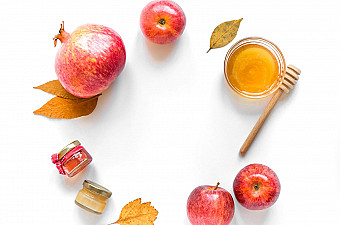
For Ashkenazi Jews, the primary symbolic food of Rosh Ha-Shanah is apples dipped in honey, a way of wishing for a sweet new year. Before eating apples and honey, say the following blessings:
Barukh atah Adonai Eloheinu melekh ha'olam borei pri ha-eitz.
Blessed are You, God, Ruler of the universe, who creates fruit of the tree.
Yehi ratzon lifanecha, Adonai Eloheinu, v'Elohai avoteinu, she'te'hadesh aleinu shanah tovah u'metukah.
May it be Your will, Adonai our God, to grant us a good and sweet year.
To bring in the new year, our litergy has songs that help us reflect on the past year and where we are going. Many modern songs can also have that effect. Some people have shared songs that help them reflect. We will listen to each followed by an explination of why the song reminds them of the new year.
In sephardi traditions, Rosh Hashanah seders typically involve foods whose meanings are symbolized with puns. Since they are often based on aramaic and hebrew, they often don't translate well. Have you ever associated beets with retreating?
Since most of us speak english more proficiently than ancient hebrew, our our seder plate has english based puns. Let's go around guessing what the different foods mean, and then we can turn the page to see other interpretations.
Right now we are at the end of the Shmita (or Sabbatical) year. At this time in ancient israel, all loans between people were forgiven. Imagine Biden's student loan forgiveness but much more widespread.
Questions to ponder:
* How do loans impact people?
* What benefits come from a society-wide loan forgiveness? What negative impacts are there?
In the 1st century BCE, Rabbi Hillel, seeing that people in need could not get loans, instituted a work around such that loans would not need to be forgiven.
Questions to ponder:
* Why were loans not available to those in need then?
* Is it possible to design a society in which some of the benefits of a periodic loan forgiveness can still exist while mitigating the negative impacts? What would this look like?
There are not easy questions, and we will not have time to solve this tonight. As we enter a new seven year Shmita cycle, we can work towards ensuring that the world in 7 years is better than it currently is today.
A new meditation — written as the year 5774 came to an end by poet Alden Solovy. May the New Year bring hope, blessing and peace. Instructions for using this meditation are found in [brackets]. May you have a year of health and happiness, joy and laughter, livelihood, sustenance, prayer and love.
Meditation on the Eve of a New Year
G-d,
Dear G-d,
We stand at the cusp of a New Year,
Looking forward, looking backward,
So much accomplished,
So much neglected,
Gains and losses,
Joys and sorrows,
Victories and defeats.
A life.
My life.
You,
G-d of Old,
You are Steadfast Witness,
Source and Shelter.
I bend my heart to You,
Recalling these gifts:
[Part 1: Think about, say out loud or write down blessings in your life, including: people, places, events and things. Be specific: a son, daughter, niece, nephew, brother or sister, by name; a wedding a birth or other joyous occasion, with names; seeing a sunrise or a rare bird; a favorite shirt, a new bed, a home repair or expansion; a new job. See how beautifully detailed and long you can make the list, seeing the many blessings that flow through your life.]
[Part 2: If you can, name the blessings that arose from sorrows, for example: a merciful death, an end to suffering or beautiful eulogy for someone, by name; rebuilding after a disaster; potential new life after a divorce. Don’t force it; be true to how you actually feel, not how you think you ‘should’ feel. If you can, try to see how, sometimes, even in times of sorrow there can be gifts.]
G-d,
My G-d,
For consolation in my grief,
For sunlight and midnight,
For hope in my celebrations,
For warmth and for shelter,
For current and tide,
For family and for friends,
For the flow of beauty and grace,
I bend my life back to You,
As the New Year descends,
In love and in service,
My offering
To Your Holy Name.
© 2014 Alden Solovy and tobendlight.com. All rights reserved.
For Ashkenazi Jews, the primary symbolic food of Rosh Ha-Shanah is apples dipped in honey, a way of wishing for a sweet new year. Before eating apples and honey, say the following blessings:
Barukh atah Adonai Eloheinu melekh ha'olam borei pri ha-eitz.
Blessed are You, God, Ruler of the universe, who creates fruit of the tree.
Yehi ratzon lifanecha, Adonai Eloheinu, v'Elohai avoteinu, she'te'hadesh aleinu shanah tovah u'metukah.
May it be Your will, Adonai our God, to grant us a good and sweet year.
To bring in the new year, our litergy has songs that help us reflect on the past year and where we are going. Many modern songs can also have that effect. Some people have shared songs that help them reflect. We will listen to each followed by an explination of why the song reminds them of the new year.
In sephardi traditions, Rosh Hashanah seders typically involve foods whose meanings are symbolized with puns. Since they are often based on aramaic and hebrew, they often don't translate well. Have you ever associated beets with retreating?
Since most of us speak english more proficiently than ancient hebrew, our our seder plate has english based puns. Let's go around guessing what the different foods mean, and then we can turn the page to see other interpretations.
Right now we are at the end of the Shmita (or Sabbatical) year. At this time in ancient israel, all loans between people were forgiven. Imagine Biden's student loan forgiveness but much more widespread.
Questions to ponder:
* How do loans impact people?
* What benefits come from a society-wide loan forgiveness? What negative impacts are there?
In the 1st century BCE, Rabbi Hillel, seeing that people in need could not get loans, instituted a work around such that loans would not need to be forgiven.
Questions to ponder:
* Why were loans not available to those in need then?
* Is it possible to design a society in which some of the benefits of a periodic loan forgiveness can still exist while mitigating the negative impacts? What would this look like?
There are not easy questions, and we will not have time to solve this tonight. As we enter a new seven year Shmita cycle, we can work towards ensuring that the world in 7 years is better than it currently is today.
A new meditation — written as the year 5774 came to an end by poet Alden Solovy. May the New Year bring hope, blessing and peace. Instructions for using this meditation are found in [brackets]. May you have a year of health and happiness, joy and laughter, livelihood, sustenance, prayer and love.
Meditation on the Eve of a New Year
G-d,
Dear G-d,
We stand at the cusp of a New Year,
Looking forward, looking backward,
So much accomplished,
So much neglected,
Gains and losses,
Joys and sorrows,
Victories and defeats.
A life.
My life.
You,
G-d of Old,
You are Steadfast Witness,
Source and Shelter.
I bend my heart to You,
Recalling these gifts:
[Part 1: Think about, say out loud or write down blessings in your life, including: people, places, events and things. Be specific: a son, daughter, niece, nephew, brother or sister, by name; a wedding a birth or other joyous occasion, with names; seeing a sunrise or a rare bird; a favorite shirt, a new bed, a home repair or expansion; a new job. See how beautifully detailed and long you can make the list, seeing the many blessings that flow through your life.]
[Part 2: If you can, name the blessings that arose from sorrows, for example: a merciful death, an end to suffering or beautiful eulogy for someone, by name; rebuilding after a disaster; potential new life after a divorce. Don’t force it; be true to how you actually feel, not how you think you ‘should’ feel. If you can, try to see how, sometimes, even in times of sorrow there can be gifts.]
G-d,
My G-d,
For consolation in my grief,
For sunlight and midnight,
For hope in my celebrations,
For warmth and for shelter,
For current and tide,
For family and for friends,
For the flow of beauty and grace,
I bend my life back to You,
As the New Year descends,
In love and in service,
My offering
To Your Holy Name.
© 2014 Alden Solovy and tobendlight.com. All rights reserved.
showing
1-6
of
24
Page
1
of
4