Yachatz
We break the middle Matzah.
And why the middle one specifically?
For we are not escaping from the past (the bottom matzah)
And we are not afraid from the future (the top matzah)
We, our hearts and spirits are living the present.
A present that combines the contemporary moments of grace
With the experience of the past, and the building of the future.
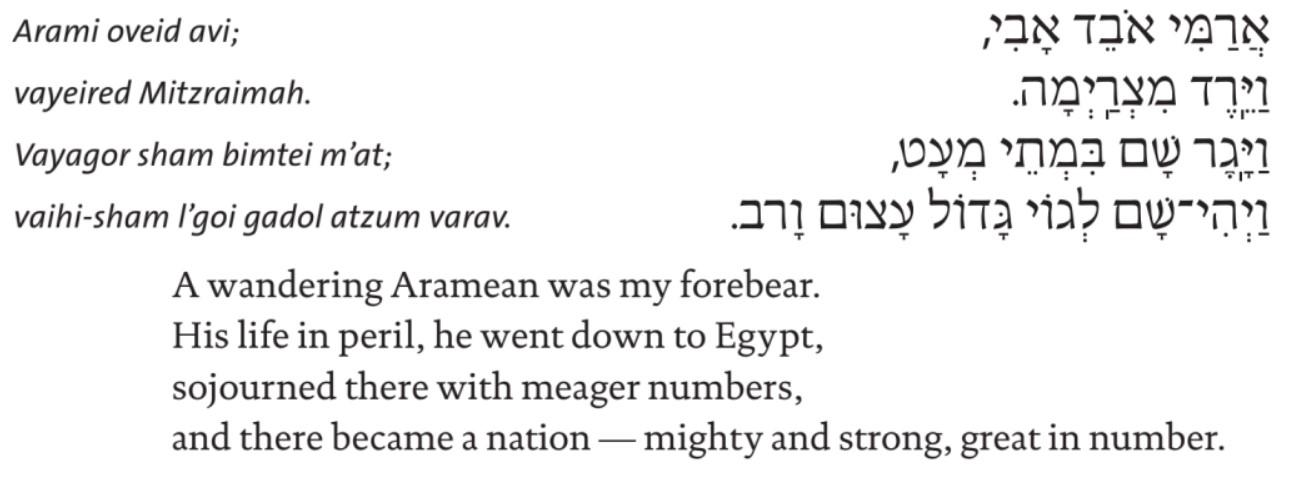
אֲרַמִּי֙ אֹבֵ֣ד אָבִ֔י
(Page 21)
Imaginary man, go. Here is your passport.
You are not allowed to remember.
You have to match the description:
your eyes are already blue.
Don’t escape with the sparks
inside the smokescreen:
you are a man, you sit in the train.
Sit comfortably.
You’ve got a decent coat now,
a repaired body, a new name
ready in your throat.
Go. you are not allowed to forget.
The New Colossus
Not like the brazen giant of Greek fame,
With conquering limbs astride from land to land;
Here at our sea-washed, sunset gates shall stand
A mighty woman with a torch, whose flame
Is the imprisoned lightning, and her name
Mother of Exiles. From her beacon-hand
Glows world-wide welcome; her mild eyes command
The air-bridged harbor that twin cities frame.
"Keep, ancient lands, your storied pomp!" cries she
With silent lips. "Give me your tired, your poor,
Your huddled masses yearning to breathe free,
The wretched refuse of your teeming shore.
Send these, the homeless, tempest-tost to me,
I lift my lamp beside the golden door!"
L'Shana Haba'ah, Next Year - לשנה הבאה
Traditionally, the Seder is wrapped up with “Next Year in Jerusalem,” whether Jerusalem as the physical location, or a spiritual manifestation. Regardless if we relate to that or not, this is also a place to express different wishes for the next year.
Over the past two years, as the Covid pandemic raged, many of us were saying “Next Year In Person,” to indicate a hope for a post pandemic world, where it’s safe to be together. While the pandemic isn’t over, we have the ability to come together safely. Given that, this “L'Shana Haba'ah”, hoping and wishing to be able to keep coming together in joy, seems fitting.
לְשָׁנָה הַבָּאָה יַחַד בְּרִינָּה
Next Year, Together in Joy
The traditional Dayenu song proclaims what would have been enough, recognizing the many blessings given to us at every step of our struggles. Tonight, let us commit ourselves to the work ahead by telling ourselves,
Lo Dayenu!
It is not enough!
If we were proud of ourselves,
But were still afraid to come out at home to family and friends,
And at school and at work,
Then it would not be enough for us.
Lo Dayenu, it would not suffice!
If we were not afraid to come out,
But did not have many diverse spiritual homes that embraced us,
And fully reflected our communities, in both leadership and group roles,
Then it would not be enough for us.
Lo Dayenu, it would not suffice!
If we had diverse spiritual homes,
But did not have full recognition and protections for our relationships
And families - in whatever way that family is - across all state and international borders,
Then it would not be enough for us.
Lo Dayenu, it would not suffice!
If we had full recognition of our families,
But many LGBTQ people still feared persecution, hate, or violence;
And other people suspected of being queer still feard the same.
Then it would not be enough for us.
Lo Dayenu, it would not suffice!
If queer people everywhere had full rights,
But we failed to recognize how class, race, and ethnicity intersects,
And how different people’s queer identities make it harder to thrive,
Then it would not be enough for us.
Lo Dayenu, it would not suffice!
לֹא דַיֵּינוּ!
It Would Not Suffice!
We have sung our dayeinus, declaring that any of God’s blessings in the past would have been enough. But in our day, dare we ever think that there are enough blessings, that no more are needed? For when we look at the world around us and see how much more is needed to perfect the world, we can only say “ lo dayeinu ” – it is not enough.
All: But the Rabbis taught, “While we are not obligated to complete all which must be done, we are obligated never to give up.” So were we to say that we truly did our part to ensure for others the safety, security, health, joy, freedom, and hope we cherish sitting at this seder table with family and friends, knowing that our work will never be completed and that there is no such thing as enough, we will have earned the right to say…dayeinu! Dayeinu!
Yachatz
We break the middle Matzah.
And why the middle one specifically?
For we are not escaping from the past (the bottom matzah)
And we are not afraid from the future (the top matzah)
We, our hearts and spirits are living the present.
A present that combines the contemporary moments of grace
With the experience of the past, and the building of the future.
אֲרַמִּי֙ אֹבֵ֣ד אָבִ֔י
(Page 21)
Imaginary man, go. Here is your passport.
You are not allowed to remember.
You have to match the description:
your eyes are already blue.
Don’t escape with the sparks
inside the smokescreen:
you are a man, you sit in the train.
Sit comfortably.
You’ve got a decent coat now,
a repaired body, a new name
ready in your throat.
Go. you are not allowed to forget.
The New Colossus
Not like the brazen giant of Greek fame,
With conquering limbs astride from land to land;
Here at our sea-washed, sunset gates shall stand
A mighty woman with a torch, whose flame
Is the imprisoned lightning, and her name
Mother of Exiles. From her beacon-hand
Glows world-wide welcome; her mild eyes command
The air-bridged harbor that twin cities frame.
"Keep, ancient lands, your storied pomp!" cries she
With silent lips. "Give me your tired, your poor,
Your huddled masses yearning to breathe free,
The wretched refuse of your teeming shore.
Send these, the homeless, tempest-tost to me,
I lift my lamp beside the golden door!"
L'Shana Haba'ah, Next Year - לשנה הבאה
Traditionally, the Seder is wrapped up with “Next Year in Jerusalem,” whether Jerusalem as the physical location, or a spiritual manifestation. Regardless if we relate to that or not, this is also a place to express different wishes for the next year.
Over the past two years, as the Covid pandemic raged, many of us were saying “Next Year In Person,” to indicate a hope for a post pandemic world, where it’s safe to be together. While the pandemic isn’t over, we have the ability to come together safely. Given that, this “L'Shana Haba'ah”, hoping and wishing to be able to keep coming together in joy, seems fitting.
לְשָׁנָה הַבָּאָה יַחַד בְּרִינָּה
Next Year, Together in Joy
The traditional Dayenu song proclaims what would have been enough, recognizing the many blessings given to us at every step of our struggles. Tonight, let us commit ourselves to the work ahead by telling ourselves,
Lo Dayenu!
It is not enough!
If we were proud of ourselves,
But were still afraid to come out at home to family and friends,
And at school and at work,
Then it would not be enough for us.
Lo Dayenu, it would not suffice!
If we were not afraid to come out,
But did not have many diverse spiritual homes that embraced us,
And fully reflected our communities, in both leadership and group roles,
Then it would not be enough for us.
Lo Dayenu, it would not suffice!
If we had diverse spiritual homes,
But did not have full recognition and protections for our relationships
And families - in whatever way that family is - across all state and international borders,
Then it would not be enough for us.
Lo Dayenu, it would not suffice!
If we had full recognition of our families,
But many LGBTQ people still feared persecution, hate, or violence;
And other people suspected of being queer still feard the same.
Then it would not be enough for us.
Lo Dayenu, it would not suffice!
If queer people everywhere had full rights,
But we failed to recognize how class, race, and ethnicity intersects,
And how different people’s queer identities make it harder to thrive,
Then it would not be enough for us.
Lo Dayenu, it would not suffice!
לֹא דַיֵּינוּ!
It Would Not Suffice!
We have sung our dayeinus, declaring that any of God’s blessings in the past would have been enough. But in our day, dare we ever think that there are enough blessings, that no more are needed? For when we look at the world around us and see how much more is needed to perfect the world, we can only say “ lo dayeinu ” – it is not enough.
All: But the Rabbis taught, “While we are not obligated to complete all which must be done, we are obligated never to give up.” So were we to say that we truly did our part to ensure for others the safety, security, health, joy, freedom, and hope we cherish sitting at this seder table with family and friends, knowing that our work will never be completed and that there is no such thing as enough, we will have earned the right to say…dayeinu! Dayeinu!
showing
1-6
of
32
Page
1
of
6